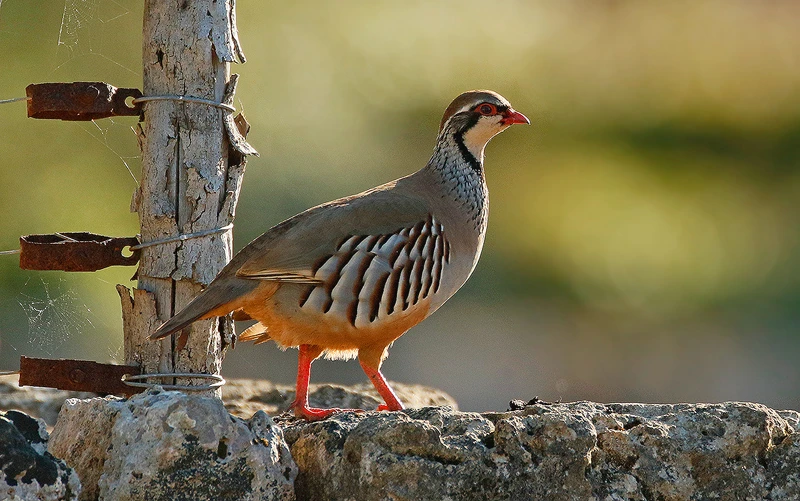
The Red-legged Partridge (Alectoris rufa), known in Spanish as perdiz roja, stands as one of the most iconic upland game birds of southwestern Europe. This social, ground-nesting species has adapted to open landscapes and remains closely linked to traditional Mediterranean farmland and mosaic habitats.
However, the species now faces a high risk of extinction in the wild across parts of its range. Consequently, it is listed as Vulnerable (VU), largely due to habitat change and other human-driven pressures.
Key facts at a glance
- Scientific name: Alectoris rufa
- Common names: Red-legged Partridge (ENG) / Perdiz roja (ESP)
- Other names: Perdiu roja (CAT) / Perdiz rubia (GAL) / Eper gorria (EUS)
- Family: Phasianidae
- Order: Galliformes
- Size: 32–34 cm
- Wingspan: 47–50 cm
- Conservation status: VU — Vulnerable
How to identify the red-legged partridge
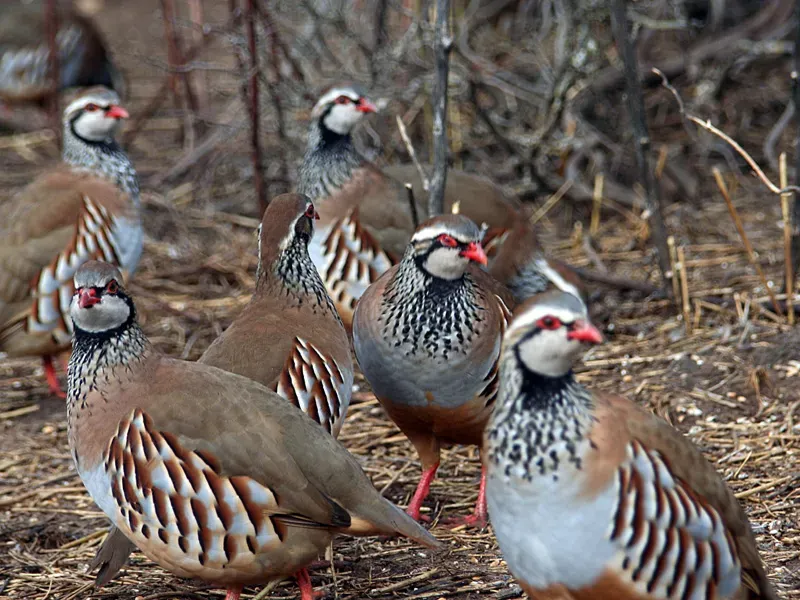
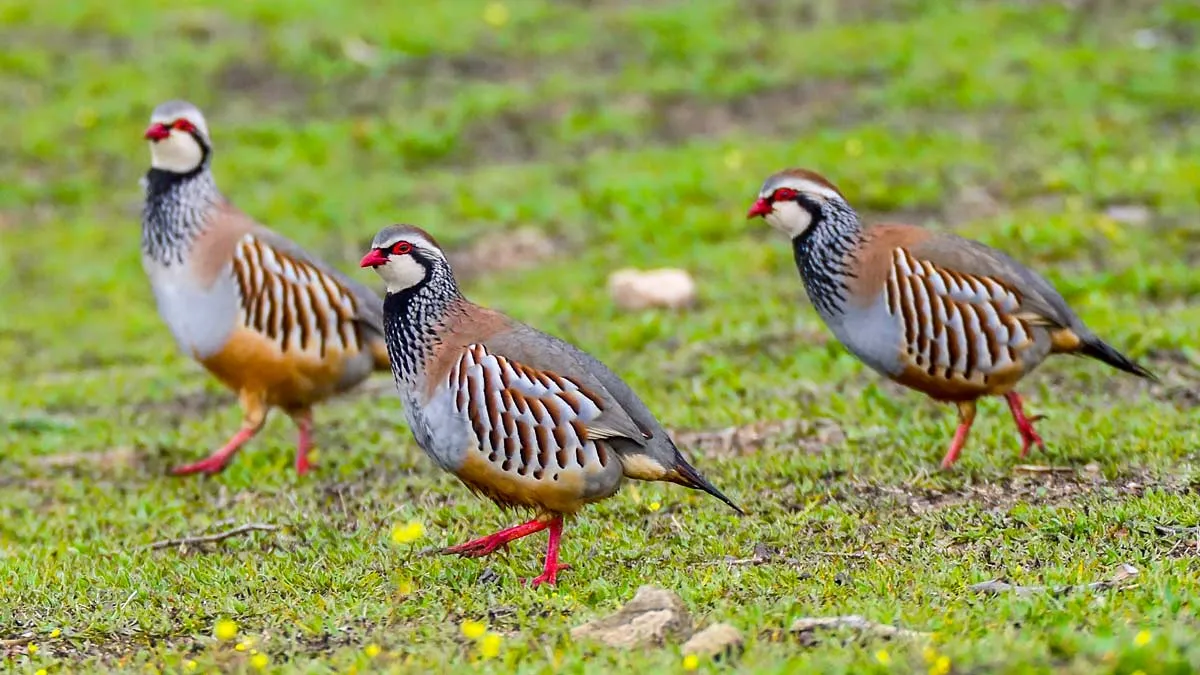
The Red-legged Partridge is a stocky, medium-sized bird. Males and females look very similar. Key field marks include an orange belly, bold barred flanks, a white throat with a dark border, a gray-brown back, and red legs, bill, and eye-ring. Chicks and juveniles are browner with more camouflaged patterns, which help them blend into grass and soil.
Flight and behavior
This species is mainly terrestrial and usually moves on foot. When flushed, it flies fast and straight, mixing strong wingbeats with short glides. The orange edges of the tail can be noticeable in flight.
Vocalizations and calls
The male’s call typically begins with short clucking notes, followed by rapid, accelerating three-syllable phrases that grow in intensity. Both sexes also produce short contact calls in different social contexts.
Where does the red-legged partridge live?
Global range
The Red-legged Partridge is a Mediterranean species naturally restricted to southwestern Europe. Specifically, it inhabits the Iberian Peninsula, France, northwestern Italy, and some Mediterranean islands.
It has also been introduced for hunting purposes in the United Kingdom, Atlantic islands (such as the Canary Islands and Azores), and in parts of North America, New Zealand, and Central Europe, with variable success. Three subspecies are commonly recognized: rufa, intercedens, and hispanica.
Distribution in Spain
In Spain, it is broadly distributed across the Iberian Peninsula and the Balearic Islands. However, it becomes scarce or absent in high mountain areas, especially above 1,500–1,800 meters.
It is generally most abundant in central and southern Spain. In contrast, it is more scarce along the Mediterranean coast, the Cantabrian coast, and the coasts of Galicia. Subspecies distribution differs by region: hispanica mainly in the north and west, and intercedens mainly in the east and south. It is present in the Canary Islands (likely introduced) and absent from Ceuta and Melilla.
Movements and seasonal patterns
The species is largely sedentary, although short altitudinal movements have been described in mountain areas during winter. Winter concentrations can be higher in regions such as Castilla-La Mancha and the Guadalquivir Valley, influenced by local management and hunting practices.
Habitat preferences
It occupies a wide variety of habitats, preferring open country or areas with scattered trees. Typical habitats include pastures, dryland crops, open scrub, dehesas, and diverse agricultural mosaics with edges and cover. It can be found from sea level up to around 2,000 meters, though it is much less common at the highest elevations.
Diet and feeding habits
The diet is mainly plant-based, including seeds, leaves, and roots, plus some arthropods. Insects are especially important for chicks during their first weeks, providing critical protein for growth.
Breeding and nesting behavior
The species is usually monogamous, although polygamy can occur. Pair formation typically happens in February and March. The nest is a shallow scrape on the ground lined with grass and feathers, hidden in vegetation.
Laying usually occurs from April to early May. Clutch size ranges from 7 to 20 eggs (commonly 10–16). Incubation lasts 23–24 days. Chicks leave the nest soon after hatching, can attempt first flights at around 10 days, and reach full development in 50–60 days.
Population and conservation status
Across Europe, population estimates are in the millions, and Spain holds an important share of the breeding population. However, monitoring programs indicate a strong decline in recent decades. As a result, the species is listed as Vulnerable (VU). This underlines the importance of effective habitat and management strategies that support wild populations.
Key threats
- Habitat loss: Landscape change linked to agricultural intensification, abandonment, land conversion, and afforestation.
- Pesticides: Treated seed can harm birds and reduce food availability for chicks.
- Unsustainable hunting: Poor management, including overharvest and genetic issues from releases and hybridization.
- Climate change: Hotter and drier conditions affect food availability and chick survival.
Recommended conservation actions
- Protect and restore key farmland habitats such as fallows, hedgerows, and field margins.
- Restrict pesticide use in sensitive areas.
- Improve hunting management and harvest controls.
- Prevent releases that do not guarantee genetic integrity.
- Expand monitoring and protect strong wild populations.
Names in Spain’s languages
- ESP: Perdiz roja
- CAT: Perdiu roja
- GAL: Perdiz rubia
- EUS: Eper gorria
- ENG: Red-legged Partridge
Listen to the red-legged partridge
The Red-legged Partridge is more than a game bird—it is a true symbol of the Spanish countryside. Elegant, fast, and challenging in flight, it is also known for a call that feels unmistakably wild and majestic. Below, you can hear the partridge’s song and get a sense of why this species is so special in Spain.
FREQUENTLY ASKED QUESTIONS
Questions about the red-legged partridge
What is a red-legged partridge (perdiz roja)?
The Red-legged Partridge is a native Mediterranean game bird found across much of Spain. For example, it is a ground-dwelling species that lives in open country and nests on the ground. Consequently, habitat quality and good management are essential for its survival.
How can I identify a red-legged partridge?
Look for a compact, medium-sized bird with a white throat, a gray-brown back, bold barred flanks, and red legs and bill. In addition, in flight it is fast and direct, often showing warm tones on the tail.
Where does the red-legged partridge live in Spain?
It is widely distributed across the Iberian Peninsula and the Balearic Islands, especially in open farmland and traditional countryside mosaics. However, it becomes scarce at higher elevations, typically above around 1,500–1,800 meters.
What do red-legged partridges eat?
Adults feed mainly on seeds and green plant matter. However, chicks rely heavily on insects during their first weeks. Consequently, healthy, pesticide-limited habitats are so important for breeding success.
Why is the red-legged partridge listed as vulnerable (VU)?
Key drivers include habitat change in agricultural landscapes, pesticide impacts, and poor management in some areas. In contrast, responsible, well-managed estates focus on habitat, sustainable harvest, and long-term quality. As a result, they play a vital role in conservation.